
The Petri Dish Paradox: What a Single Stem Cell Taught Me About Depression

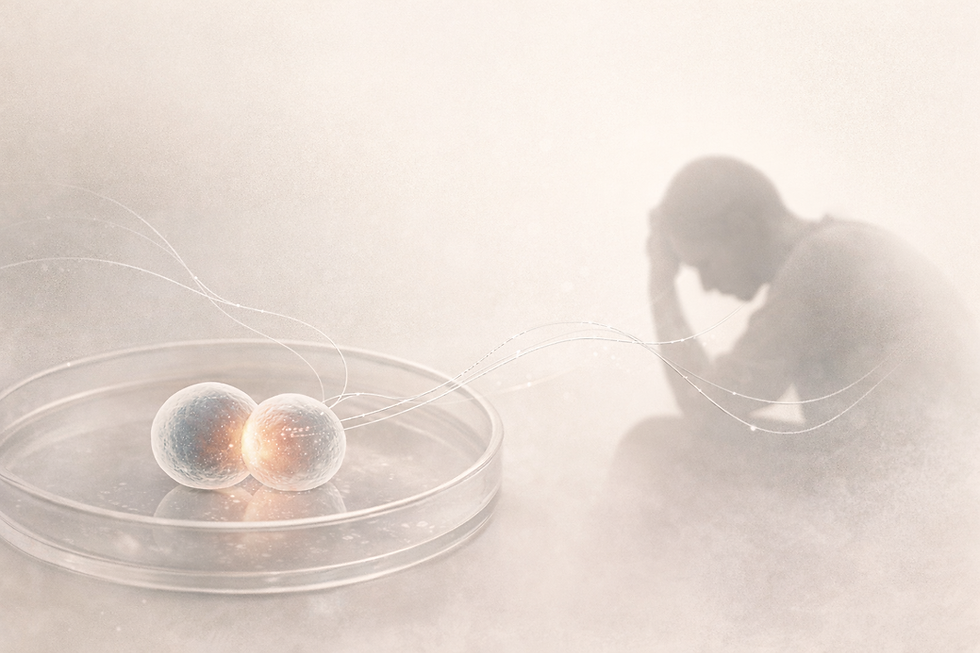
In 2010, I was working in a lab that studied the morphogenesis of early vertebrate embryos. My advisor was a well-known figure in the field, but not a man of many words. He communicated mostly through data, not stories.
One afternoon, while we were attempting to derive germ cells from induced pluripotent stem cells, he asked me a question.
“Do you know what happens if you place only one stem cell in a petri dish?”
I looked up from the bench.
“I’ve tried it many times,” he said. “No matter how many nutrients I add, or what chemical signals I use to trigger differentiation, nothing really happens. The cell just sits there. It isn’t dying, but it isn’t becoming anything either.”
He paused.
“But when I place another stem cell beside it, something changes. They begin to organize. It’s as if they need the presence of the other to decide what to become—a neuron, a vessel, a piece of skin. Without that relationship, direction often fails to emerge.”
At the time, I nodded and went back to my work. I was a student. My world was protocols, markers, and incubation times. The story stayed somewhere in the background of my mind for years.
More than a decade later, I found myself sitting across from a patient who described depression not as sadness, but as stillness. A heavy, quiet emptiness. Life was not unbearable. It was simply unmoving. Nothing seemed worth starting. Nothing seemed worth becoming.
And suddenly, that single stem cell returned to me.
A perfectly nourished environment.
All the right conditions.
And yet, no differentiation.
Not because the cell was defective.
But because it was alone.
In biology, we often speak about differentiation—the process of becoming what a cell is meant to be. But that process rarely happens in isolation. Cells signal to one another. They respond, adjust, and coordinate. Identity, even at the microscopic level, emerges through relationship.
Human beings are not so different. This is not every form of depression, but it is one I have seen often.
A person can be surrounded by resources—education, career success, financial stability—and still feel strangely motionless inside. From the outside, everything appears intact. But internally, something essential is missing: the sense of connection that gives direction to effort, meaning to work, and warmth to existence.
What many high-functioning individuals call “burnout,” “emptiness,” or “loss of purpose” often carries the same quiet quality as that single cell. Not collapse. Not chaos. Just stillness.
As a therapist, I don’t think of healing as simply adding more “nutrients” to someone’s life—more productivity, more coping strategies, more self-optimization. Those are often already present.
What is usually missing is connection.
Not just social contact, but a deeper form of relational signaling, such as:
someone who sees you without needing you to perform
a space where your inner world actually matters
a relationship that allows movement, not just survival
Because just like that stem cell, human beings rarely discover who they are meant to become in complete isolation.
If you ever feel strangely still—well-resourced, outwardly functional, yet internally unmoving—it may not be because something inside you is broken.
It may simply mean you have been trying to become someone
without anyone to become them with.
Disclaimer: This article represents a personal and professional reflection informed by my background in developmental biology and my clinical experience as a psychotherapist. It is intended to offer a conceptual, systems-level perspective on the nature of isolation and dormancy, rather than providing a diagnostic or treatment framework.
Depression is an inherently heterogeneous condition influenced by a complex interplay of factors, including acute or chronic trauma, significant life events, neurobiological predispositions, circadian rhythm disruption, and metabolic, hormonal, or nutritional variables. The biological metaphor explored here—while a powerful lens for understanding the impact of disconnection—is not intended to capture every presentation of depression, nor is it a substitute for individualized clinical assessment, diagnosis, or professional care.
Engagement with this content does not establish a therapist-patient or consultant-client relationship. If you or someone you know is experiencing thoughts of self-harm or a mental health crisis, seeking immediate professional support is strongly encouraged.
Resources:
National Suicide & Crisis Lifeline (USA): Call or text 988.
Crisis Text Line: Text HOME to 741741.
Emergency: Please dial 911 or visit your nearest emergency room.


Comments